What is an annuity?
An annuity is a retirement savings plan similar to bank savings accounts and CDs. They are issued by an insurance company, that provides income payments to an annuitant or beneficiary, beginning immediately (immediate annuity) or at a future date (deferred annuity).
There are generally two stages in the life of an annuity. The accumulation phase, during which contract values build, and the payment phase, when the contract values are distributed.
What are the benefits of an annuity?
An annuity is the only product which has the ability to provide you with a lifetime income guarantee. It has better interest rates and more tax advantages.
More people are turning to personal annuities for help in building a bigger nest-egg for retirement. If you are looking to maximize your retirement savings, consider a fixed deferred annuity or an equity-indexed annuity.
In addition, although tax reform (TRA ’86) eliminated most tax shelters, personal limits or minimum distributions requirements at age 70 1/2, and, while contributions to personal annuities are not tax deductible, all earnings accrue tax deferred until withdrawn, giving an annuity tremendous growth potential.
How do I choose a company?
There are approximately 1,800 insurance companies in the United States that sell annuities. While some consumers prefer to buy annuities directly from a company, most people buy them through agents or brokers. Much of the information provided here will be helpful whichever way you decide to buy an annuity.
Before purchasing an annuity, check the company’s financial condition. You can do this by asking the agent or requesting information from your state’s insurance department. A number of insurance rating services rate the financial strength of companies.
You can access companies ratings from Standard & Poor’s, Moody’s, A.M. Best, and Duff & Phelps – four of the largest rating services.
What is a Fixed Tax-Deferred Annuity?
A fixed tax-deferred annuity, also referred to as a tax-deferred annuity, is a contract between you and an insurance company for a guaranteed interest bearing policy with guaranteed income options. The insurance company credits interest, and you don’t pay taxes on the earnings until you make a withdrawal or begin receiving an annuity income. Your annuity contract earns a competitive return that is very safe.
Tax-Deferred?
Tax-deferred means postponing your taxes on interest earnings until a future point in time. In the meantime you earn interest on the money you’re not paying in taxes. You can accumulate more money over a shorter period of time, which ultimately will provide you with a greater income.
Savings Advantages
Many people today are using tax-deferred annuities as the foundation of their overall financial plan instead of certificates of deposit or savings accounts. Although CD’s and annuities are very similar there are significant differences between the two. The most important difference is that annuities allow for the deferral of the taxes due on the interest earned until the interest is withdrawn. By postponing the tax with a tax-deferred annuity, your money compounds faster because you can earn interest on dollars that would have otherwise been paid to the IRS. Later, if you decide to take a monthly income, your taxes can be less because they will be spread out over a period of years. Like Certificates of Deposits, annuities have a penalty for early surrender, however most annuity contracts have a liberal “free withdrawal” provision.
Tax Advantages
You pay NO taxes while your money is compounding. You can also pay a lower tax on random withdrawals because you control the tax year in which the withdrawals are made, and only pay taxes on the interest withdrawn, Tax deferral gives you control over an important expense – your taxes. Any time you control an expense, you can minimize it. The longer you can postpone this particular expense, the greater your gain when compared to the gain you would make with a fully taxable account.
The Tax-Deferred Advantage
To illustrate the increased earning capacity of tax-deferred interest, compare it to a fully-taxable earning. $25,000 at 6.0% will earn $1,500 of interest in a year. A 28% tax bracket means that approximately $420 of those earnings will be lost in taxes, leaving only $1,080 to compound the next year. If these same earnings were tax-deferred, the full $1,500 would be available to earn even more interest. The longer you can postpone taxes, the greater the gain.
Tax-Deferred vs. Fully Taxable
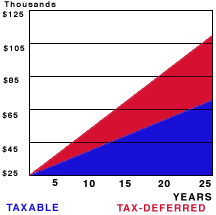
Compare the Return
$107,297 Accumulated in a Tax-Deferred Annuity
$71,966 Accumulated in a Taxable Account
The Difference:$35,331
Note: That at an annuities guaranteed rate of 4%, the return after 25 years would be $66,646.
No More 1099’s
There is no withholding tax while your annuity is compounding; it is completely tax-deferred. If you request a distribution (random withdrawals or annuity income), back taxes will be withheld – unless you elect differently. Your election not to withdraw can be made at the time you make your request. Because the interest is tax-deferred, it is not necessary to issue a Form 1099 while your money is compounding. Only when your interest is distributed (withdrawal or annuity income) will a Form 1099 be sent, reflecting the amount of interest actually received.
When Does My Money Mature
An annuity policy does not “mature” like a bond or certificate of deposit (CD). Both your principal and interest will automatically continue to earn interest until withdrawn or you reach age 100. You can let your money continue to grow, make withdrawals, or begin receiving an annuity income at any time.
What is the Penalty Tax and When Does it Apply?
An IRS penalty tax, currently 10%, must be payable on any withdrawal of interest or qualified premium made prior to age 59 1/2.
Avoid Probate
If a premature death should occur, the accumulating funds within your annuity may be transferred to your named beneficiaries, avoiding the expense, delay, frustration and publicity of the probate process. Like most assets, the annuity is part of your taxable estate. Your heirs can chose to receive a lump sum payment, or a guaranteed monthly income.
Leave a Reply
You must be logged in to post a comment.